
{主关键词}
那年花开月正圆
China's earliest tinned iron armor found in Zhejiang: 1,700-year-old anti-rust tech revealed_我的网站

A |
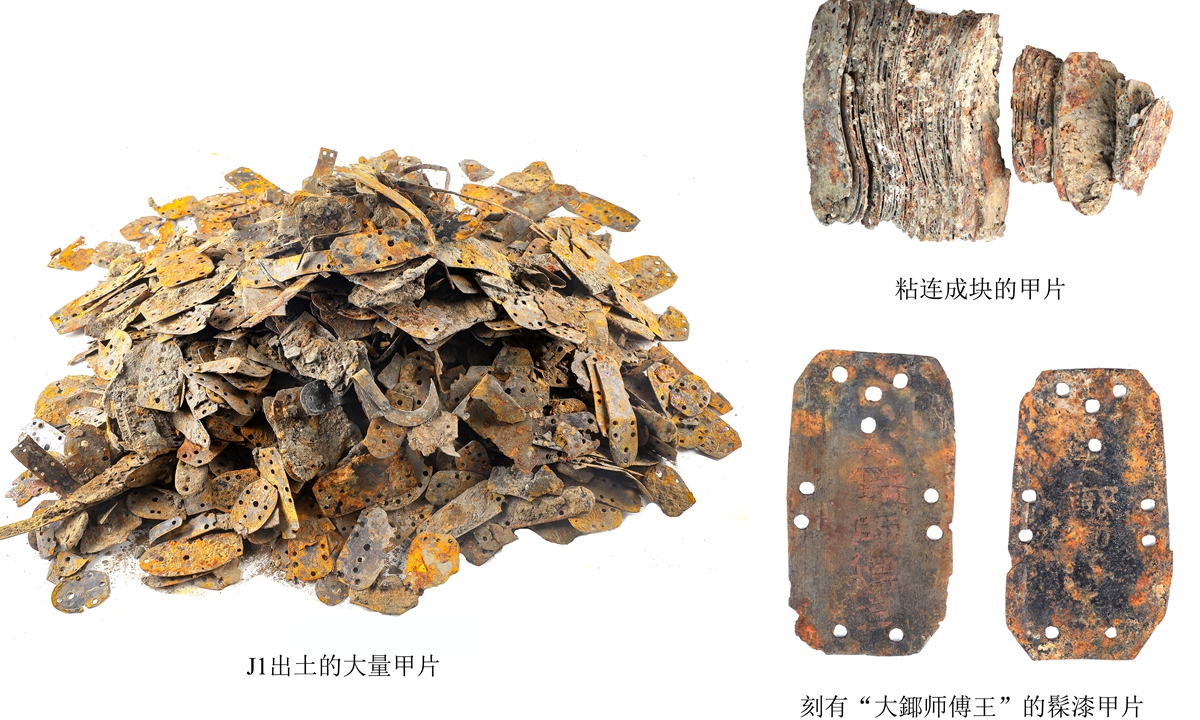
While China has a long history of making tinned bronze and tinware, there has long been a lack of reliable historical records or physical evidence to prove early local production of tinned iron artifacts. The newly discovered armor plates can fill this gap, demonstrating that, by no later than the Wu period, local craftspeople in Zhejiang Province had mastered the art of tin-plating iron surfaces. This reflects the region's advanced metallurgical skills at that time, Ge Shuaikun, a researcher at the Shaoxing Institute of Cultural Relics and Archaeology, told the Global Times on Tuesday.
Over the last three years, archaeologists working at the Jizhong ruins site have excavated hundreds of tinned iron armor plates from ancient wells and ash pits. A preliminary investigation confirmed that the surfaces of these plates contain high levels of tin. Subsequent laboratory analyses were conducted in collaboration with the Shaoxing's institute and the Institute for Cultural Heritage and History of Science & Technology at the University of Science and Technology Beijing with methods such as Scanning Electron Microscopy with Energy Dispersive Spectroscopy (SEM-EDS), X-ray Diffraction (XRD), and Micro-CT to deeply examine the samples' materials, structures, and technological traces.
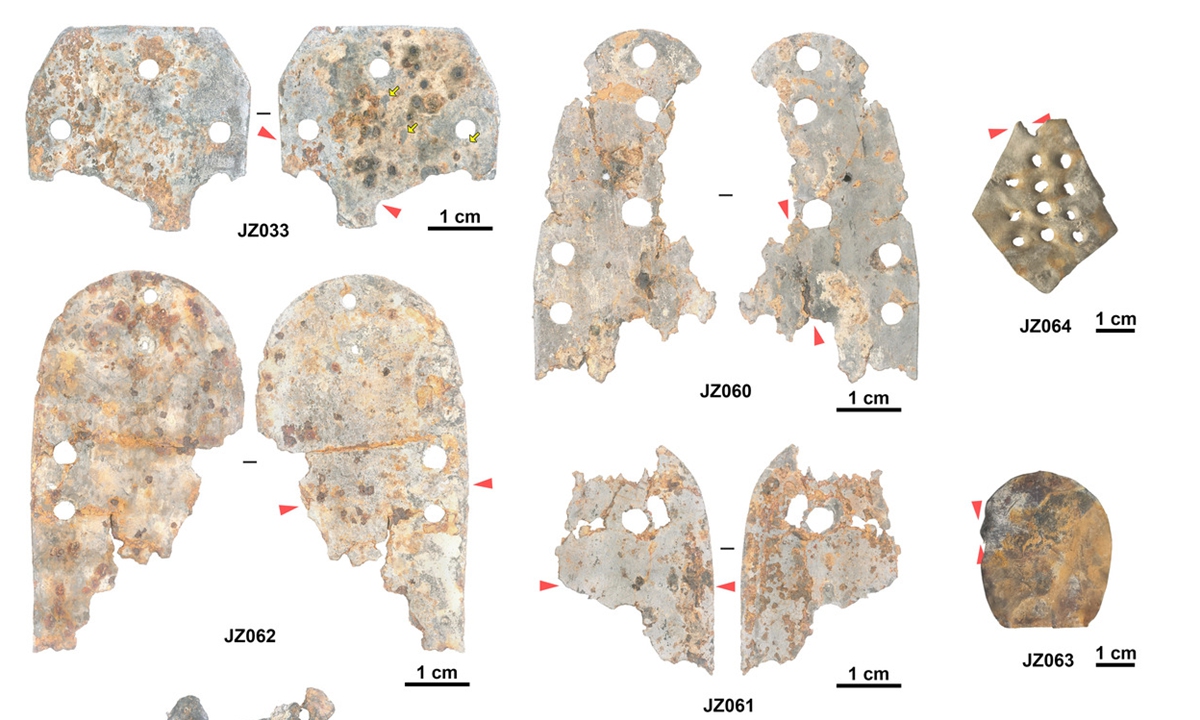
Research shows that the craftspeople immersed iron armor plates in molten tin, thus ensuring complete coverage of the surface with a continuous tinned layer. This coating isolated the iron from exposure to air and moisture, dramatically boosting corrosion resistance. Many of the excavated tinned armor pieces still show a clear, bright silver-white finish.
One major reason for tin-plating the armor was to prevent rust. At the same time, the silvery white shine of tinned iron offered a more striking, beautiful appearance, standing out from the typical dark iron armor of the era. This visual distinction may have marked these pieces as a higher-grade military asset, according to an article from the University of Science and Technology Beijing's official website.
The article said that in earlier eras, from the pre-Qin to Han dynasties, tin was widely used as a surface coating on bronzeware and ceramics. Researchers believe the tin-plating of iron armor discovered at the Jizhong ruins site during the Wu period of Three Kingdoms built upon this local tin-coating tradition, representing an adaptation of those techniques across different materials. The process likely benefited from technological exchange among various specialized workshops at the site, including those making bronze castings, iron weapons, and other metallurgical products.
。
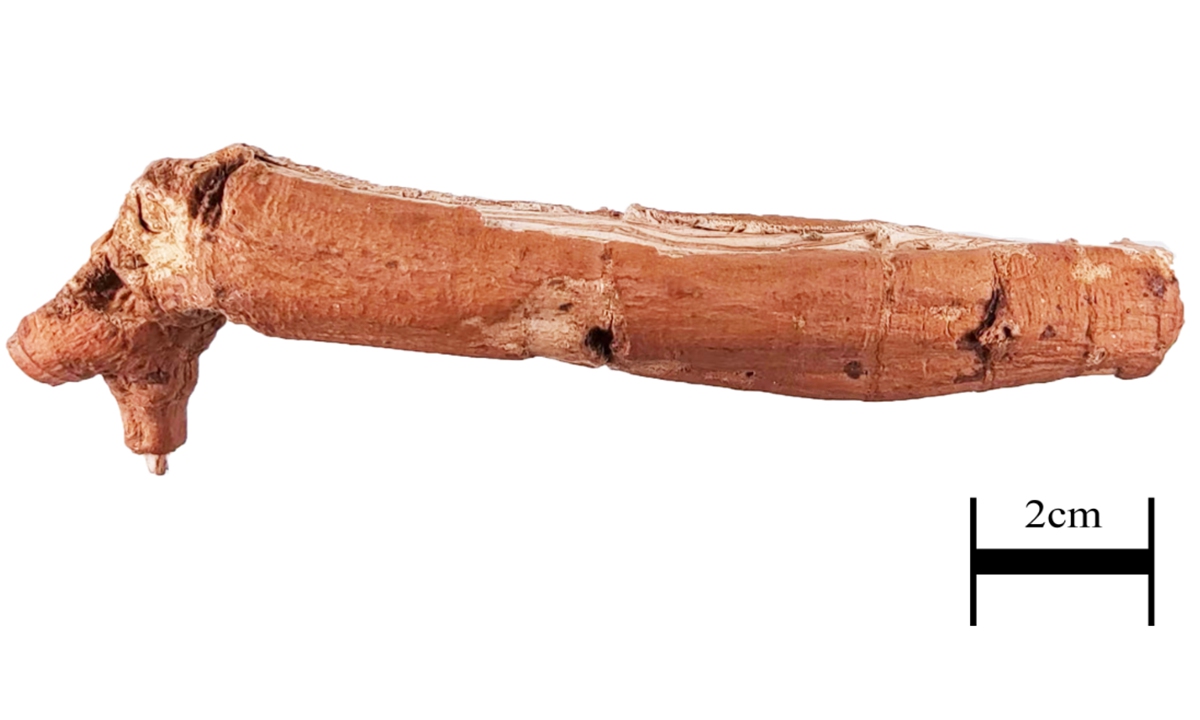
A Chinese research team has identified a new potential target to develop antidepressant drug from Qingyangshen, or Root of Auricledleaf Swallowwort, a traditional ethnic medicinal plant long used in Southwest China's Yunnan Province, according to Kunming University of Science and Technology, Science and Technology Daily reported Sunday.
The team, led by professors Xu Tianrui and Xiang Cheng from the university's School of Life Science and Technology, found that Qingyangshen glycosides, the plant's core active compound, can alleviate depression-related behaviors by simultaneously suppressing inflammation, reducing oxidative damage and stabilizing neurotransmitters in the brain.
The findings were published in the international journal Phytomedicine.
Depression has become a widespread mental health disorder globally, while existing clinical drugs fail to provide effective treatment for more than 30 percent of patients, according to the researchers. Previous studies have established a strong link between chronic inflammation and depression, but existing anti-inflammatory drugs have limited targeting capabilities, underscoring the need for new therapeutic targets and lead compounds.
Qingyangshen, a plant of the Cynanchum genus in the Apocynaceae family, has long been used as a traditional medicine by ethnic groups including the Naxi, Yi and Bai peoples in Yunnan, mainly for treating neurological conditions such as epilepsy and neurasthenia.
The researchers systematically examined the pharmacological effects of Qingyangshen extract and its core active compound, Qingyangshen glycosides. Tests using mouse, zebrafish and fruit fly models repeatedly showed that the compound significantly improved depression-related behaviors induced by inflammation, according to the report.
To identify the compound's target, the team developed a dual-discrimination model for four subtypes of prostaglandin E2 receptors and combined it with AI-powered machine learning. The researchers screened hundreds of G protein-coupled receptors and identified the prostaglandin E2 subtype 4 receptor as the direct target of Qingyangshen glycosides.
Multiple molecular experiments confirmed that the compound binds directly to the receptor and acts as an inhibitory ligand. Further experiments involving animals with the receptor knocked out in the hippocampus showed that the antidepressant effects of Qingyangshen glycosides disappeared completely when the receptor was absent, providing the first in-vivo evidence that the receptor is essential for the compound's therapeutic effects.
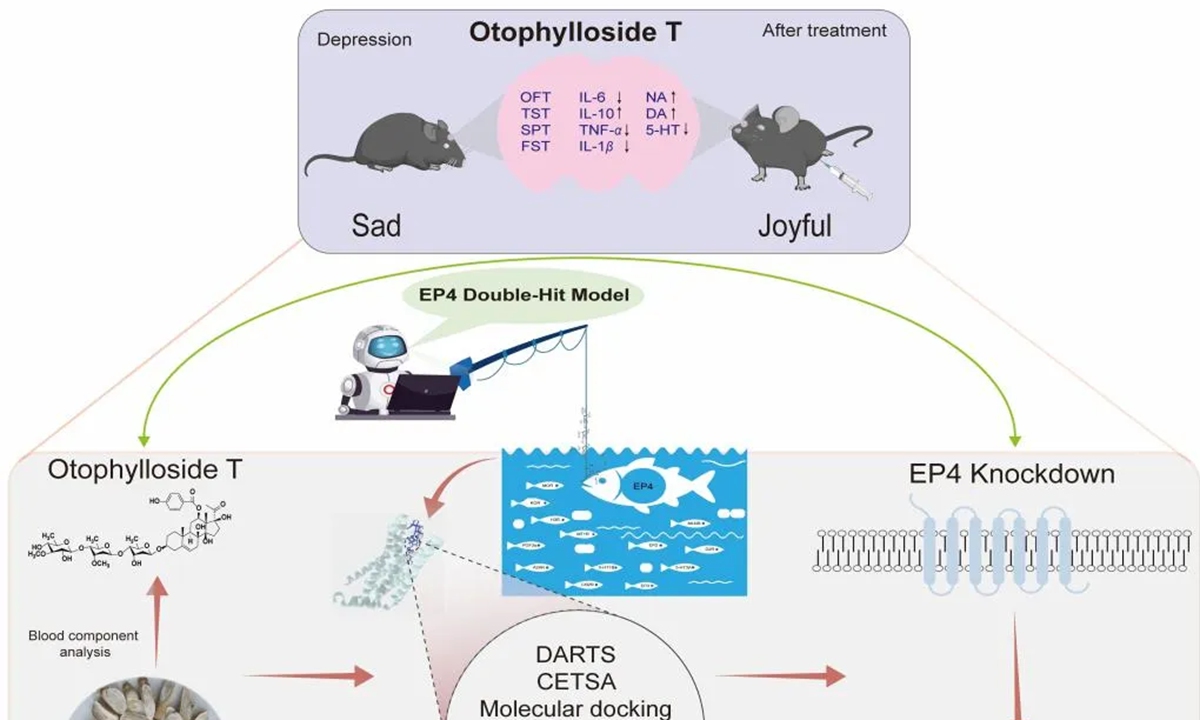
The study establishes the prostaglandin E2 subtype 4 receptor as a potential new target for antidepressant drug development and points to a new approach to treating depression through inflammatory pathways. It also identifies Qingyangshen glycosides as a potential lead compound for developing highly targeted anti-inflammatory antidepressants, creating a research chain from ethnic medicinal plants and active compounds to drug targets and new drug development.
Global Times
。
Current article:http://wym5q9.shangfochengcongshuaizhuang.buzz/acw/jmt9ypi.html
Published on:00:25:32
- 上一篇:腾讯联合拳头公司成立腾津体育
- 下一篇:上海体彩暖心帮扶困难残疾体彩代销者
- 2309853《乌鲁木齐蜘蛛山野房车自驾营地攻略:进疆中转驻车太省心了》
- 9696274政声直达丨1至7月河北经济运行总体平稳向新向优
- 2027566夸利亚雷拉:莱奥此前表态想离开米兰,现在归队后需重新证明自己
- 9185809네팔 홍수에 한국인 8명 연락두절…두산·남동발전 긴급 대응
- 2850845一向奉公守法的新加坡人,在邻国却是“欠款大户”?
- 9527808可超万兆内存!七彩虹推出X870E火神白主板:双USB4 售3999元
- 74399Kinzinger Warns of ‘Christian Taliban’ After Boebert Critiques US Separation of Church and State
- 64810更好服务长三角与新疆地区经贸往来 “上海—乌鲁木齐”快线正式发布,更好服务长三角与新疆地区经贸往来 “上海—乌鲁木齐”快线正式发布
- 2280083PM to dedicate Rs 15,670 cr projects during two day Gujarat visit
- 638李乐成主持召开制造业企业座谈会,围绕产业人才队伍建设听取意见建议
- 1206771非承载车身+华为896线激光雷达 北京越野泰坦700上市:24.98万起
- 9278913漫步者 Comfo Clip Q2 智能耳夹耳机发布:海思谛听芯片 + 开源鸿蒙,399 元
- 7452郭艾伦:提出转会申请是职业生涯最重要的决定
- 9205《GTA6》遭超大泄露!R星愤怒抓捕泄密者 遭疯狂玩梗
- 561日喀则市启动自然灾害救助一级应急响应
- 40527热点透视|大力培养优秀青年科技人才
- 17093炸锅!17岁张本美和连斩国乒3将登顶WTT,未来3年谁能拦住她?
- 59353苹果计划全面更新Mac产品线
- 231622026宁夏民营企业百强榜单于石嘴山发布 民企方阵实力稳步攀升,2026宁夏民营企业百强榜单于石嘴山发布 民企方阵实力稳步攀升
- 591892贝索斯离婚的处理速度可以和亚马逊送货一样快。
- 8819440售25.35万元起 小米YU7正式上市 一文看懂YU7如何成为新起点
- 6321111戴夫·弗兰科与《Idiots》卡司详解这部喜剧中最具爆炸性的场景
我的网站热门国内
- Copyright @ 2016-2017 我的网站 版权所有